The technology of treatment of lead battery scrap and other types
of secondary lead raw material with soda-free electric smelting application
The Fund for Technological
Development of the RF Ministry
for Science and Technology has assigned the
RF State Research Center "Gintsvetmet "to
implement the Research and Development Project titled
"Development of integrated technology for
waste-free and environmentally sound processing
of secondary lead raw materials". It
includes preparation of technical documentation
for construction of a module-type facility
with a capacity of 15,000 tonnes of lead per year.
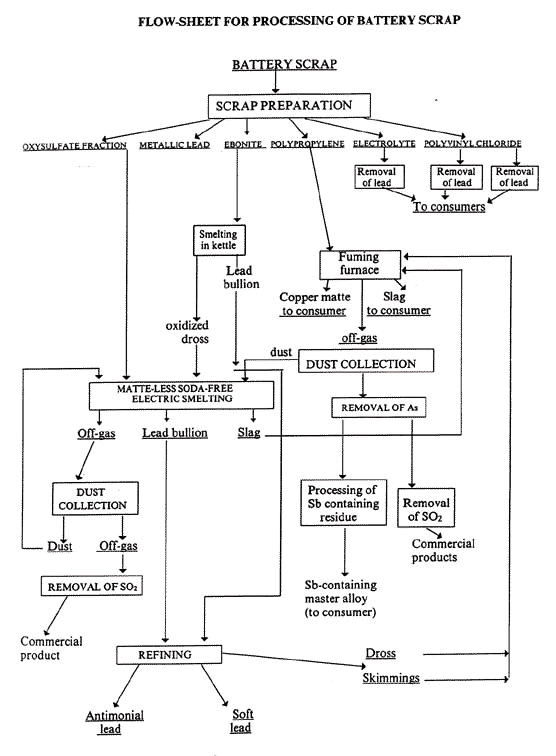
The flow-sheet for waste-free processing
of spent lead batteries (see Figure) comprises the following
unit operations: mechanized preparation of
battery scrap, smelting, refining of lead
bullion, and processing of recycled wastes
to produce commercial products.
An analysis of the existing technologies
for battery scrap preparation offered by a number
of companies has indicated that
the most suitable technology for the
conditions of Russia is the processes of Engitec
Impianti SpA (Italy). The CX-compact unit is environmentally
sound and requires only limited amount of
construction, low
capital investments, and a short installation period; it
ensures separation of batteries into five fractions: metallic, oxysulfate,
polypropylene, polyvinyl chloride, and ebonite.
Smelting of lead-containing scrap is
performed in an electrothermal furnace using the technology
developed in the Gintsvetmet Institute
differs from the conventional processes in the fact
that no soda is used as fluxing agent, no matte
is formed in the process, and the amount
of slag produced is minimized, because
slag formation depends only on the ash content of the coke used and the
quality of scrap separation.
The process has been patented.
The technology has been commercially
introduced using a 1,8 MVA furnace with a
bottom area of 12 m2 at the AO "Ryaztsvetmet plant. Currently,
preparations are made for introducing this
technology at another plant in Russia.
Technical performance values of electric smelting process:
Specific productivity with respect to lead bullion 4,5 t/m2
per day
Electric power consumption per 1 t of lead
480-520 kWh
Coke requirement (carbon)
3-4%
Slag output
3-5%
Irrecoverable loss of lead
<1-1,5%
Slag temperature
1100-1150'C
Lead temperature
900-950 C
Amount of process off-gas
200-250 Nm3/t Pb
The main advantages of the
proposed technology by comparison with the blast-furnace
smelting and smelting in a short-barrel rotary kilns are as follows:
- no technical-grade oxygen is used which results in a considerablly less
amount of process off-gas; with similar gas treatment facilities
the volume of emissions of lead-containing dust and sulfur
dioxide per unit of lead produced is reduced by 3-5
times;
- reduction in dust entrainment and amount of recycled products;
- lower slag yield (3-5% instead of 20-25%);
- lower coke requirement (3-4% instead of 10-14%).
Refining of lead bullion is accomplished
using the conventional technology, but some of the refining techniques
imply certain know-how.
Processing of products of the electrothermal smelting
of lead scrap (i.e.. slag, dross, skimmings) and ebonite
fraction is performed in a fuming
furnace of an unique proprietary design.
As a result of the charge smelting process in
the fuming furnace the following products are obtained:
slag containing 0,1% Pb and 0,18% Cu
and copper matte containing 25,0% Cu and 1,5% Pb.
The natural gas and blowing air
requirement is 230 m3 and 5000 m3 per tonne of charge,
respectively. Ebonite fraction is used as reductant.
The proposed technology does not
generate any wastes and ensures production of the
following commercial products:
1. Lead of "CO" and "C1" grade or antimonial lead.
2. Copper matte.
3. Bismuthous lead.
4. Antimonial master alloy.
5. Slag.
6. Gypsum (or other sulfur-containing products).
7. Polypropylene.
8. Polyvinyl chloride.
All unit operations included in
the process flow-sheet have been designed to comply with
the statutory environmental regulations of the Russian Federation.
The proposed flow-sheet for processing
battery scrap is intended to be used for engineering designs
and implementation at Russian enterprises on
the basis of cooperation between RF State
Research Center "Gintsvetmet"and Engitec Irnpianti SpA
(Italy).